


What is the AM2 assessment? A complete guide
If you’re considering a career as an electrician, or are already training to become one, you’ve probably heard about the AM2 assessment. In this guide, we’ll give you a complete overview of what the AM2 involves, why it matters, and how to prepare so you can approach it with confidence.
What is the AM2 assessment?
The AM2 assessment, sometimes called the AM2 exam or Unit 399, is the final practical assessment that every NVQ Level 3 Electrical candidate must complete. It tests your competence as either an installation or maintenance electrician, ensuring that you have the skills, knowledge and safety awareness required to work in the trade.
Completing the AM2 is a mandatory requirement for anyone wishing to apply for their JIB ECS Gold Card, which is an industry-recognised identification card confirming your competence and eligibility to work on site. This card is widely recognised by employers and contractors across the UK, making it essential for career progression.
The assessment is maintained and overseen by the independent body NET (National Electrotechnical Training Organisation), which ensures that the assessment is rigorous, fair, and in line with current industry standards. Candidates take the AM2 at a local registered assessment centre, where the examiners monitor each section to make sure the work is completed safely and correctly.
Why are there different versions of the AM2?
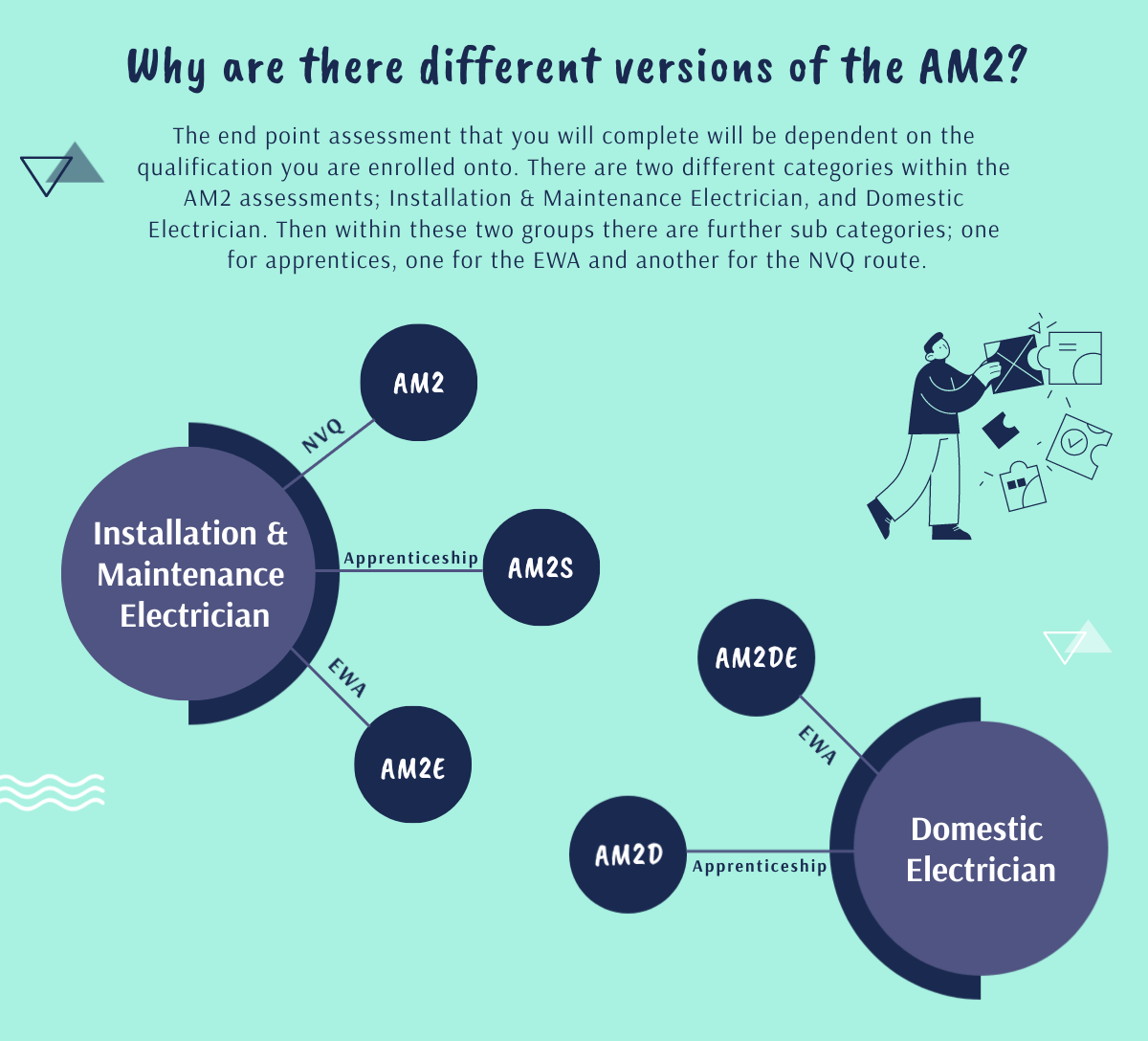
There are several different versions of the AM2 assessment, each designed to suit specific career paths and specialisms within the electrical industry. There are two groups: Installation & Maintenance Electrician, and Domestic Electrician. We’ll explain the key differences below, but feel free to visit NET’s website for more clarification on exactly what’s involved.
Installation & Maintenance Electrician
Within the Installation & Maintenance Electrician category, there are three versions of the assessment: AM2, AM2S and AM2E. While they mostly cover the same content, there are a few differences that are tailored to the different learning paths. The standard AM2 is for those enrolled on the Level 3 Electrotechnical NVQ (or equivalent). Unlike the AM2S, which is for apprentices, and the AM2E, which is for those enrolled on the Experienced Worker pathway, the AM2 does not include Containment as part of the assessment.
Domestic Electrician
Similarly, the Domestic Electrician category is broken down into two individual assessments that cover the same main content: AM2D and AM2ED. The AM2D is designed for apprentices on the Domestic Electrician apprenticeship standard, and includes a final scenario-based interview that isn’t covered in the AM2ED, which is for those enrolled on the Experienced Worker Assessment.
What does the AM2 exam consist of?
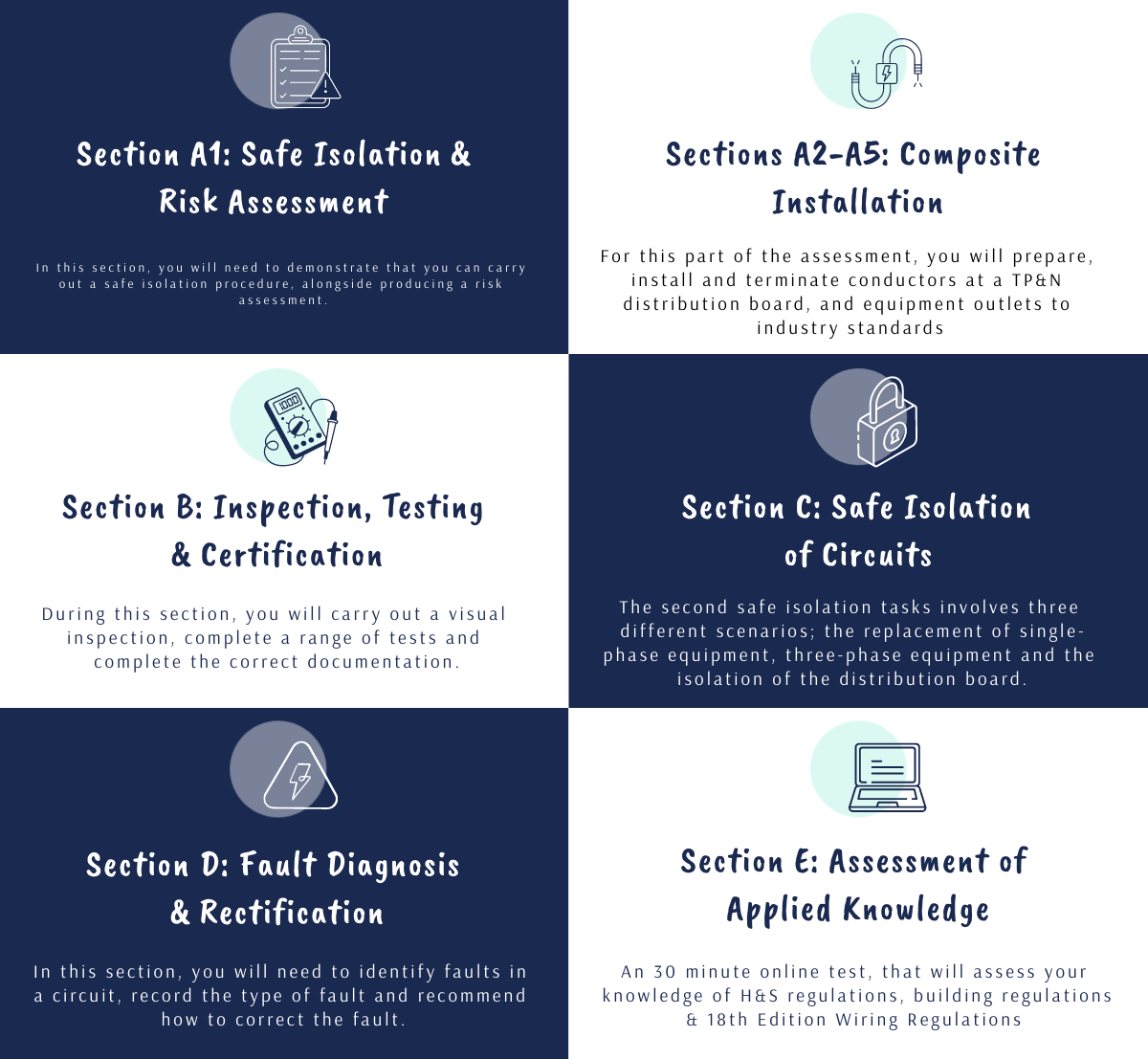
The AM2 exam is divided into different sections, each assessing key electrical skills that are essential for competent, safe work. These sections vary slightly depending on whether the candidate is undertaking an Installation & Maintenance Electrician or Domestic Electrician qualification. There are also minor differences in the content for full-time education, apprenticeship or experienced worker pathways, which you can explore in full on NET’s website. For now, let’s take a look at what’s covered in each section.
Safe Working Practices
This section is only included in the Domestic Electrician assessment, covering both the AM2D and the AM2ED. It’s designed to ensure that domestic electricians can work in occupied homes safely, responsibly, and to professional standards. Candidates must show that they understand how to minimise risks, follow correct procedures, protect themselves and others, and maintain compliance with relevant regulations while carrying out everyday electrical tasks.
Safe Isolation & Risk Assessment
This section focuses on safe isolation and risk assessment procedures, which are crucial for working with electrical circuits. Candidates must demonstrate that they can identify hazards, follow isolation procedures correctly, and assess risks to themselves and others. This section is observed by assessors as you carry out practical isolation tasks and complete a written risk assessment, showing that you understand both legal requirements and best practice in site safety.
Composite Installation
This section covers composite installation, and assesses practical skills in wiring, assembly and connection. Candidates will complete a range of installation tasks that simulate real-world electrical work, including circuit installation, connection of devices, and compliance with wiring regulations. For the AM2S and AM2E only, Composite Installation also assesses Containment. Assessors look for accuracy, quality of workmanship and adherence to safety standards to show that you can undertake typical installation work competently and efficiently.
Inspection, Testing & Certification
This section assesses the ability to inspect and test electrical installations and issue certification. This includes completing standard forms, identifying faults, measuring electrical parameters, and confirming compliance with current regulations. Candidates must show attention to detail, knowledge of testing equipment, and the ability to interpret results correctly to ensure that the installations you work on are safe and compliant.
Safe Isolation of Circuits
This section also follows the theme of safety, focusing on the isolation of circuits during practical work. Candidates are tested on procedures for safely disconnecting power, verifying isolation, and documenting the work performed. This section reinforces the importance of consistent safety practices, which protect both the electrician and anyone else working on the site.
Fault Diagnosis & Rectification
This section assesses your troubleshooting and problem-solving skills. Candidates must identify faults in a given installation, propose corrective actions, and carry out repairs safely. This section tests practical knowledge, logical thinking, and familiarity with common electrical issues. Successful completion demonstrates that you can resolve problems effectively and make sure installations operate reliably.
Assessment of Applied Knowledge
The final section evaluates your applied knowledge of electrical principles, regulations and industry standards. Candidates answer scenario-based questions to demonstrate that they can make informed decisions, apply regulations correctly, and justify their approach to real-world problems. This section is essential for showing that your practical skills are underpinned by a solid understanding of theory and legislation.
Scenario-Based Interview
The scenario-based interview only applies to apprentices undertaking the AM2D Domestic Electrician assessment. Following the assessment of applied knowledge, candidates will be required to sit a structured interview based on realistic on-site scenarios. During the interview, you’ll be asked to justify decisions, explain how you would approach particular problems, and demonstrate that you can apply regulations, safety principles, and technical understanding to situations you may encounter in domestic properties.
Where do I complete the AM2?
The AM2 assessment can be completed at any of 50+ registered assessment centres across England, Wales and Northern Ireland. Each centre provides a controlled environment with the necessary equipment and materials needed to simulate real-world electrical work. Many candidates choose centres close to their home or training location, and some employers will even arrange assessment at a preferred centre.
At Electrician Training 4 U, we offer Level 3 NVQ in Electrical Installation and City & Guilds 2357 NVQ Level 3 Electrical Installation Diploma, along with support for candidates preparing to take the AM2 assessment. However, because the AM2 is an independent assessment, it must be taken at a registered NET-approved assessment centre rather than with the training provider where you complete your course. If you choose to study with us, we can help you to find a suitable assessment centre.
How do I prepare for my AM2?
Preparing for the AM2 is crucial to success. Understanding what to expect and practising the necessary skills can make a significant difference on assessment day. Here are some top tips for making sure you’re ready.
Practise risk assessments
Make sure you’ve had opportunities to practise risk assessments as part of your study and on-the-job training. Accurately identifying hazards and mitigating risks is a key part of the AM2, particularly in sections A1 and C. Risk assessments are one of the most common areas for candidates to struggle with, so extra preparation here could mean the difference between a pass and a fail.
Complete a self-assessment
NET provides a readiness for assessment checklist to help candidates gauge whether they’re prepared to take the AM2. Completing a self-assessment will help you to identify areas where further study or practice is needed, and can be a great confidence boost before the actual exam.
Familiarise yourself with the testing and inspection forms
Download and review the template forms used for inspection and testing. Knowing how these forms work will help you to complete them correctly under time pressure and avoid making mistakes during section B of the assessment.
Study the regulations
A strong knowledge of electrical regulations and industry standards is essential not just for passing the AM2 exam but also for your career as an electrician. Make sure you understand how to apply the regulations to justify the decisions you make during practical tasks and scenario-based questions.
Attend a pre-assessment day
Some centres offer pre-assessment days. These sessions allow candidates to ask questions, review wiring diagrams, observe examples of risk assessments and more. Attending these sessions can give you practical insights and reduce anxiety before the final assessment.
AM2 assessment frequently asked questions
What are the AM2 entry requirements?
The AM2 is an end-point assessment for the NVQ Level 3 electrical qualification, so candidates must be enrolled in this course for either electrical installation or maintenance. Competence in practical electrical work, theory knowledge and safety awareness is expected before attempting the AM2.
How much does it cost to take the AM2 exam?
The cost of taking the AM2 exam varies depending on the centre and the version of the assessment that you take. The current recommended price for an AM2 assessment is £860. Further information on this assessment cost and separate retake fees can be found on the NET website.
Is the AM2 an open book exam?
The AM2 is primarily a practical assessment, where candidates are expected to demonstrate knowledge, skills and decision making. However, you will be able to refer to relevant materials during the assessment that will be provided for you, including up-to-date copies of electrical legislation, risk assessments, and NET’s Candidate Manual. You can find out more about these documents in NET’s pre-assessment manual.
What is the AM2 exam pass rate?
Pass rates vary by cohort and centre, but the majority of candidates who complete adequate preparation succeed. Common areas where candidates struggle include risk assessment documentation, inspection and testing forms, and fault diagnosis tasks. Practising these areas thoroughly can improve your likelihood of passing.
Interested in becoming an electrician?
If you’re thinking about training to become an electrician, the AM2 assessment is a crucial step in your journey. This exam ensures that you can work safely, competently, and in line with industry standards. By completing the AM2, you gain eligibility for the JIB ECS Gold Card, opening doors to career opportunities across the UK and giving employers confidence in your abilities.
EC4U’s courses are designed to prepare you for every stage of your electrical training, including the AM2. We provide structured support, practical guidance, and access to assessment preparation resources so that you can take the assessment with confidence. Contact us today to find out how we can help you achieve your goal of becoming a qualified electrician.